
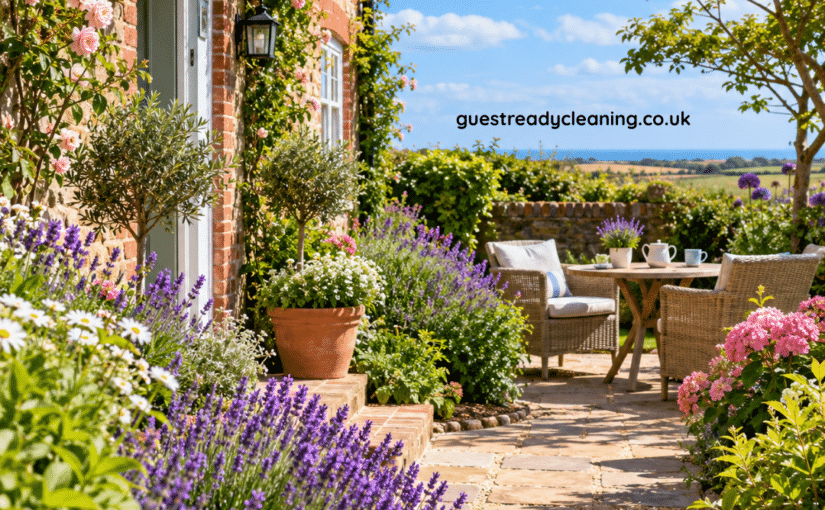
Beautiful, practical planting that welcomes guests, supports wildlife and doesn’t demand constant attention.
There’s something rather lovely about arriving at a Norfolk holiday cottage and discovering a garden that immediately makes you want to stay a little longer.
Perhaps it’s the scent of lavender drifting across a sunny courtyard, the gentle movement of grasses in the breeze or a sheltered corner with a table and chairs, perfectly placed for that first cup of tea. It needn’t be a grand garden. Sometimes a handful of well-chosen plants, a little greenery and somewhere comfortable to sit are all it takes to make an outdoor space feel special.
For holiday guests, a garden is part of the experience. Somewhere to enjoy a leisurely breakfast, read a book in the afternoon sunshine or sit outside as the evening draws in. It’s often these quieter moments that become the fondest memories of a holiday.
For holiday let owners, however, there’s another side to the story. Gardens need looking after, and plants have little regard for changeover days, busy booking calendars or owners who live several hours away.
The good news is that creating a low-maintenance holiday let garden in Norfolk doesn’t mean sacrificing colour, character or the pleasures of a proper garden. With thoughtful design, plants suited to the local conditions and a manageable maintenance routine, it’s possible to create an outdoor space that looks beautiful throughout the seasons without becoming a constant responsibility.
And often, the secret lies in working with nature rather than against it.
What Makes a Good Holiday Let Garden?
A holiday cottage garden has a rather different purpose from the garden we might create for ourselves.
At home, we may happily spend an afternoon dividing perennials, pottering amongst the borders or deciding that a shrub would look much better somewhere else. For many of us, tending the garden is part of the pleasure.
Holiday guests, on the other hand, are usually looking for somewhere to enjoy rather than somewhere to work.
A good holiday let garden should feel welcoming from the moment someone arrives. Paths should be easy to navigate, seating should be comfortable and the planting should offer enough colour, greenery and seasonal interest to make the space feel cared for.
But the garden also needs to work for the owner.
Plants that demand daily watering, shrubs that quickly outgrow their space and elaborate borders requiring constant attention can turn a charming outdoor area into a surprisingly demanding commitment.
The most successful holiday cottage gardens strike a balance. They feel natural and relaxed, but never neglected. They offer the beauty of a traditional garden without expecting someone to spend every weekend maintaining it.
And achieving that balance begins with understanding the place itself.
Gardening in Norfolk: Working With the Landscape
Norfolk has a landscape all of its own. From the open skies and salt-laden breezes of the coast to the sheltered lanes, villages and countryside further inland, the county offers wonderfully varied conditions for gardening.
Those differences matter when choosing plants.
Along parts of the North Norfolk coast, gardens may be exposed to strong winds, salt spray and sandy, free-draining soils. Summer drought can be a particular challenge, especially in gardens where the soil struggles to retain moisture.
Further inland, conditions may be quite different. Heavier soils, winter waterlogging, sheltered pockets and areas prone to frost all influence which plants will thrive.
Norfolk is also one of the drier parts of the UK, so choosing plants that can tolerate occasional dry spells is particularly sensible for holiday accommodation.
Before planting anything, it’s worth spending time getting to know the garden.
Notice where the morning sunshine falls and which areas remain shaded in the afternoon. Look for corners sheltered from the prevailing wind and places where the soil dries quickly after rain. Observe whether established trees compete for moisture or cast shade across the borders.
These small observations can save a surprising amount of work later.
A lavender planted in heavy, waterlogged soil will struggle, however lovely it looked in the garden centre. Equally, a moisture-loving plant placed in an exposed, sandy border may require far more attention than a holiday let owner can reasonably provide.
The right plant in the right place is one of the simplest principles of low-maintenance gardening.
When plants are growing in conditions that suit them, they’re generally healthier, more resilient and less demanding. That means less watering, fewer replacements and a garden that becomes easier to care for as it matures.
Choose Shrubs That Provide Structure Throughout the Year
If there’s one group of plants worth making room for in a low-maintenance garden, it’s shrubs.
They give a garden its backbone, providing structure and interest long after the summer flowers have faded. Some offer glossy evergreen foliage, others bring blossom, autumn colour or berries, and many provide valuable shelter for wildlife.
Once established, carefully chosen shrubs can look after themselves remarkably well, needing little more than occasional pruning and seasonal attention.
For Norfolk holiday cottage gardens, a mixture of evergreen and deciduous shrubs can create an attractive planting scheme that doesn’t disappear completely during winter.
Shrubs worth considering
Hebe can be particularly useful in sheltered coastal gardens. Compact varieties offer attractive evergreen foliage and flowers that appeal to pollinating insects. Choose hardy varieties carefully, as not all hebes cope equally well with severe frost or exposed conditions.
Escallonia is another useful choice for many coastal locations, particularly where conditions are relatively mild. Its glossy leaves and summer flowers provide interest, while established plants can tolerate salt-laden winds.
Shrubby cinquefoil (Dasiphora fruticosa) is a cheerful, hardy shrub with a long flowering season. It thrives in sunny positions and is generally content with occasional pruning to maintain its shape.
Choisya ternata, often called Mexican orange blossom, offers fragrant white flowers and handsome evergreen foliage. It’s particularly lovely near a doorway or seating area, where its scent can be appreciated. A sheltered position away from cold, drying winds is best.
There’s no need to fill every available space with shrubs. In fact, one of the most common mistakes is planting too closely together.
That modest little shrub in its nursery pot may eventually grow several feet across. Giving plants room to reach their natural size not only looks better but also reduces the need for endless cutting back.
A few thoughtfully placed shrubs can do far more for a garden than a crowded border full of plants competing for space.
Perennials: Colour Without Replanting Every Spring
There’s a particular satisfaction in seeing familiar plants return each year.
The first fresh shoots of a hardy geranium, the silvery foliage of lavender coming back into growth or the sturdy stems of a hylotelephium appearing as the soil begins to warm are all welcome signs that the gardening year is moving on.
For a holiday let, hardy perennials are wonderfully practical.
Unlike seasonal bedding plants, which often need replacing, feeding and frequent watering, established perennials return year after year. Many also provide nectar and pollen for bees, butterflies and other insects.
Some particularly useful choices include:
English lavender (Lavandula angustifolia)
Few plants seem more at home in a sunny Norfolk garden. Lavender brings fragrance, soft colour and a steady stream of pollinating insects during summer. It thrives in free-draining soil and benefits from an annual trim to help prevent it becoming woody.
Salvia nemorosa
With its upright flower spikes in shades of violet, blue and purple, salvia brings welcome colour to sunny borders. Established plants cope with periods of dry weather, and cutting back spent flowers can encourage further flowering.
Hardy geraniums
Reliable, generous and wonderfully useful for filling gaps, hardy geraniums soften border edges and help cover bare soil. Some varieties flower over a long period, while others are particularly valuable for ground cover.
Hylotelephium, formerly known as sedum
These sturdy perennials come into their own towards the end of summer, when their broad flowerheads begin attracting pollinators. They thrive in sunny, well-drained positions and their fading seedheads can provide attractive winter structure.
Rather than scattering individual plants throughout the garden, try planting in generous groups.
A sweep of lavender beside a path or a drift of hardy geraniums beneath established shrubs creates a more natural, settled appearance. It also makes maintenance easier, as the plants gradually fill the available space.
The result is a garden that looks increasingly established with each passing year.
Let Ground-Cover Plants Help With the Weeding
Anyone who has spent time gardening will know that weeds have an extraordinary ability to appear just when everything is looking particularly tidy.
Bare soil offers the perfect opportunity for unwanted seedlings to establish, and keeping large areas of exposed earth clear can become a never-ending job.
One of the simplest ways to reduce weeding is to cover the soil with plants.
Low-growing, spreading perennials can fill the spaces between shrubs, soften paths and create a more natural appearance while helping to limit opportunities for weeds to establish.
Hardy geraniums are particularly useful, while bergenia provides handsome evergreen leaves and spring flowers, especially in partial shade.
Creeping thyme can be lovely in sunny, well-drained spots and between paving where foot traffic is light. Certain low-growing sedums are also useful for dry, sunny areas.
The important thing is to choose plants that spread at a manageable rate.
A vigorous ground-cover plant may keep weeds down, but if it begins taking over paths and neighbouring borders, you’ve simply exchanged one maintenance problem for another.
The aim is a garden that settles comfortably into itself, with plants growing together naturally rather than constantly competing for attention.
Mulching: A Small Job That Makes a Big Difference
Mulching isn’t the most glamorous gardening task, but it’s one of the most useful.
A generous layer of suitable organic mulch, such as composted bark or woodchip, can help retain soil moisture, suppress weeds and gradually improve the soil as it breaks down.
For Norfolk holiday let gardens, where watering may not always be practical between bookings, that can make a real difference.
Apply mulch to moist, weed-free soil, keeping it away from the stems of plants and the trunks of shrubs and trees. A layer of around 5–7.5 cm is often suitable for ornamental borders, depending on the material used.
Spring is a particularly useful time to mulch, before the main growing season gets underway, although it can be beneficial at other times when conditions are suitable.
As well as reducing maintenance, mulch gives borders a pleasingly finished appearance.
It won’t eliminate weeds altogether, and organic mulch will eventually need topping up, but it’s one of those simple gardening jobs that rewards a little effort with considerably less work later.
Does Your Holiday Let Really Need a Lawn?
A green lawn can be a lovely feature in a holiday cottage garden.
It offers somewhere for children to play, space for a picnic and a welcome contrast to flowering borders. For family-friendly accommodation, a manageable area of grass may be well worth keeping.
But lawns aren’t always the easiest option.
During the growing season, grass needs mowing regularly, while edges, worn patches and seasonal growth all require attention. In dry summers, lawns may also turn brown, particularly on sandy soils.
Before committing to a large lawn, consider how guests are likely to use the space.
A family holiday cottage may benefit from an open grassy area. A smaller property welcoming couples might be better served by a comfortable patio, attractive planting and perhaps a modest patch of grass.
Reducing the size of a lawn can make garden maintenance considerably easier without losing the sense of greenery.
And there’s no need to insist upon a perfectly striped finish.
Allowing grass to grow slightly longer during dry weather can help reduce stress, while a small area of longer grass, where practical, may provide shelter for wildlife.
A holiday cottage garden should feel inviting and comfortable, not as though someone has spent the entire morning preparing it for a gardening competition.
Gravel Gardens and Drought-Tolerant Planting
For sunny, free-draining Norfolk gardens, gravel planting can be an attractive and practical choice.
There’s something especially appealing about the combination of pale stone, fragrant herbs, silvery foliage and flowering perennials. It feels relaxed, natural and particularly suited to parts of the Norfolk coast.
Lavender, thyme and suitable salvias can all work beautifully in well-drained planting areas, alongside other plants chosen for the garden’s particular conditions.
A thoughtfully designed gravel garden can reduce the amount of lawn and create an attractive setting for drought-tolerant plants.
However, gravel isn’t maintenance-free.
Leaves and debris still need clearing, weeds can establish in accumulated organic matter and loose surfaces may need occasional attention.
It’s also worth remembering that deep or loose gravel can be difficult for wheelchair users, people with limited mobility and families with pushchairs.
For holiday accommodation, firm, stable and accessible paths should always take priority.
A combination of practical paving, gravel planting areas and well-chosen borders often offers a better balance than covering the entire garden with loose stone.
And there’s certainly no need to remove every living thing in the pursuit of an easier garden.
A Garden for Every Season
Norfolk has a particular beauty throughout the year.
Spring brings fresh growth and the first flowering bulbs. Summer fills the countryside with colour, while autumn offers golden light, seedheads and the changing colours of leaves. Even winter has its pleasures, with bare branches, evergreen foliage and the quiet structure of a garden at rest.
A successful holiday let garden should reflect those changing seasons.
After all, visitors don’t arrive only in June and July.
In spring, naturalised daffodils and crocuses can bring early colour, alongside flowering shrubs and fresh foliage. Once established, many spring bulbs return reliably with relatively little attention.
In summer, lavender, salvias, hardy geraniums and ornamental grasses provide fragrance, movement and colour during the busiest holiday months.
In autumn, hylotelephiums, ornamental grasses, berries and changing foliage help keep the garden interesting as the days grow shorter.
In winter, evergreen shrubs, interesting bark and the remaining structure of perennials prevent borders from feeling completely bare.
Leaving some perennial stems and seedheads standing through winter can also provide shelter and food for wildlife.
They can be tidied in late winter or early spring, before new growth gets underway.
The idea isn’t to create a garden that looks identical in every month. It’s to allow the planting to follow the natural rhythm of the seasons, so there’s always something worth noticing.
The Practical Details Guests Will Appreciate
It’s easy to become absorbed in choosing plants, but the most successful holiday cottage gardens are about much more than flowers.
Think about how someone arriving for the first time will use the outdoor space.
Can they find the front door easily? Is there somewhere pleasant to sit? Are paths clear and stable? Can guests enjoy the garden without having to move heavy furniture or navigate overgrown shrubs?
A simple, well-positioned patio with comfortable seating may offer far more enjoyment than an elaborate border that leaves little room for relaxing.
Choose outdoor furniture that’s durable, easy to clean and appropriate for the conditions. In exposed coastal gardens, lightweight furniture may need securing or storing during windy weather.
Keep paths reasonably level and free from encroaching plants, and avoid placing thorny shrubs close to frequently used routes.
For family-friendly and dog-friendly holiday lets, plant selection deserves particular care. Some familiar ornamental plants can be poisonous if eaten, while others have irritating sap, thorns or sharp foliage.
Outdoor lighting can also make entrances and paths easier to use after dark. Choose suitable fittings and avoid unnecessary light spill that could disturb wildlife.
These practical considerations might not be the most exciting part of garden design, but they’re often the details that make an outdoor space genuinely enjoyable.
Creating a Wildlife-Friendly Holiday Cottage Garden
One of the pleasures of staying in Norfolk is feeling connected to the surrounding countryside.
The sound of birds in the hedgerows, bees moving amongst the flowers and butterflies visiting a sunny border all add something special to a garden.
And encouraging wildlife doesn’t require a large space or an elaborate planting scheme.
A native hedge can provide food and shelter for birds and insects. Flowering perennials offer nectar and pollen, while shrubs, grasses and seedheads create useful habitats throughout the year.
Even a small courtyard can support pollinators with a few well-chosen containers.
Where space allows, a modest patch of longer grass can add habitat, while leaving some stems standing over winter gives insects somewhere to shelter.
A wildlife-friendly garden needn’t look neglected. Thoughtful planting, clearly maintained paths and a comfortable seating area can sit very happily alongside more natural corners.
In fact, gardens that work with wildlife often have a softer, more settled character.
There’s something wonderfully restful about sitting outside on a summer evening, listening to birdsong and watching the last of the day’s bees amongst the flowers.
It’s a reminder that a garden doesn’t have to be perfectly manicured to be beautiful.
Low-Maintenance Doesn’t Mean No Maintenance
However carefully a garden is designed, it will always need some attention.
Plants need watering while they establish, particularly during dry spells. Shrubs occasionally require pruning, borders need weeding and paths must be kept clear.
Lawns grow, leaves fall and the occasional spell of rough weather can leave branches, debris or damaged planting behind.
But there’s a considerable difference between a garden that needs sensible seasonal care and one that constantly demands attention.
Good low-maintenance garden design reduces unnecessary work.
Established shrubs replace plants that need constant renewal. Hardy perennials return each year. Mulched borders retain moisture more effectively, and plants suited to the conditions are less likely to struggle.
The remaining jobs become part of a manageable routine rather than an endless list of things waiting to be done.
For holiday let owners, particularly those living away from Norfolk, that makes regular garden maintenance an important part of looking after the property.
Planning Holiday Let Garden Maintenance in Norfolk
A garden doesn’t stop growing because the holiday cottage is fully booked.
In fact, some of the busiest periods for holiday accommodation coincide with the fastest-growing months in the garden.
Spring and early summer bring vigorous lawn growth, weeds and rapidly developing shrubs. Later in the year, fallen leaves, changing weather and winter preparation bring their own jobs.
Having a regular holiday let gardening and maintenance routine helps prevent small tasks from becoming much larger problems.
Depending on the property and season, garden maintenance might include lawn mowing, weeding, pruning, border care, clearing leaves, keeping paths tidy and checking for weather-related damage.
Some smaller gardens may only need occasional visits, while properties with lawns, hedges or extensive borders are likely to require more frequent attention during the growing season.
It’s worth reviewing the garden regularly rather than relying upon the same schedule throughout the year.
A little work at the right time can prevent an overgrown hedge, neglected border or untidy entrance from becoming a much bigger undertaking.
And when gardening is coordinated with holiday let cleaning and general property maintenance, it becomes easier to keep the whole property looking welcoming between bookings.
After all, first impressions begin at the garden gate, not the front door.
A Garden That Welcomes Guests and Works for Its Owner
Picture a warm afternoon at a Norfolk holiday cottage.
The path is clear, lavender is flowering beside the patio and the borders are filled with plants that seem perfectly at home in their surroundings. A few bees are busy amongst the flowers, ornamental grasses move gently in the breeze and there’s a comfortable chair waiting in a sheltered patch of sunshine.
Nothing feels overly formal or fussy.
Yet everything looks cared for.
The plants have been chosen to suit the soil and conditions. The shrubs have room to grow, the borders are established and the outdoor space offers somewhere genuinely pleasant to spend time.
For guests, it’s a garden to enjoy.
For the owner, it’s a garden that can be maintained without endless watering, pruning and replanting.
And perhaps that’s what makes a successful low-maintenance holiday let garden so appealing. It doesn’t ask us to give up the things we love about gardens. It simply encourages us to choose them more thoughtfully.
Because the loveliest holiday cottage gardens aren’t necessarily the grandest or the most carefully manicured.
They’re the ones that make you want to pull up a chair, enjoy the surroundings and stay a little longer.
Holiday Let Gardening Services in Norfolk
At Guest Ready Cleaning, we know that caring for a holiday property involves more than preparing the rooms for the next arrival.
The garden, entrance and outdoor spaces are all part of the welcome, and keeping them looking their best throughout the year can be challenging, particularly for owners who don’t live nearby.
Alongside our holiday let cleaning, deep cleaning and property maintenance services, we offer gardening services to help Norfolk holiday property owners keep their outdoor spaces tidy, attractive and ready for guests.
Whether it’s a small courtyard, a traditional cottage garden or a larger outdoor space requiring regular attention, we can help take care of those jobs that are so easily overlooked during a busy booking season.
A well-maintained garden makes a lovely first impression. A reliable maintenance routine helps keep it that way.
To find out more about our holiday let gardening and property care services in Norfolk, visit guestreadycleaning.co.uk or email hello@guestreadycleaning.co.uk.
Contact us to talk about cleaning, laundry and changeover services for your North Norfolk holiday home.
For Inspiration Follow Us on Instagram, Threads, BlueSky
Further Reading: Creating a Cosy Christmas Stay for Your Guests, How Often Should You Deep Clean a Holiday Home?